THE SECULAR TAROTIST
tarot without the mysticism
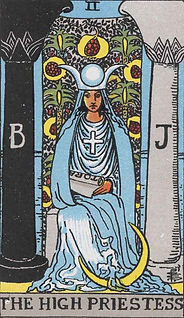
The High Priestess sits quietly between two pillars, crowned by the moon. Behind the pomegranate veil lies a body of water. Who knows what hides in its depths? In line with traditional interpretations, we can take this card to be about the subconscious, the source of our intuition and creativity.
Psychologist Daniel Kahneman says our minds are involved in two distinct types of mental operations:
Type 1 is automatic, effortless, often unconscious, and associatively coherent. . . . Type 2 is controlled, effortful, usually conscious, tends to be logically coherent, rule-governed. Perception and intuition are Type 1. … Type 2 is more controlled, slower, is more deliberate. . . . Type 2 is who we think we are. [And yet] if one made a film on this, Type 2 would be a secondary character who thinks that he is the hero because that’s who we think we are, but in fact, it’s Type 1 that does most of the work, and it’s most of the work that is completely hidden from us.
A great deal of human behavior stems from our subconscious mind. Type 1 processes allow us to ride a bike without consciously thinking about how to keep balance, but also to make a decision without rationally weighing the pros and cons for hours on end. We just 'do what feels good', i.e., we follow our 'intuition'. Intuition (literally 'knowledge from within') is basically subconscious pattern recognition. There's nothing magical to it: as Albert Einstein noted, it's "nothing but the outcome of earlier intellectual experience”. But the unique power of the subconscious is that it balances this swift synthesis of previous experience with free-flowing associative thinking that is able to synthesize across domains.
The workings of this part of our mind are exemplified in dreaming, and even daydreaming. When we allow our conscious mind to let go of its incessant control, like in the moment just before we fall asleep, we experience the subconscious bobbing to the surface. We notice our thoughts making strange leaps and bounds, often harking back to whatever occupied us that day. It just goes to show what a crazy layer of consciousness lurks beneath the surface of our minds.
But beware, for intuition is not without bias. It may see causal relationships where there are none. It suppresses doubt and creates overconfidence. Kahneman calls it a “machine for jumping to conclusions.” So we have to know when to listen to it, and when to distrust it. Philosophy professor Massimo Pigliucci writes:
Intuition is a domain-specific ability, so that people can be very intuitive about one thing (say, medical practice, or chess playing) and just as clueless as the average person about pretty much everything else. Moreover, intuitions get better with practice — especially with a lot of practice — because at bottom intuition is about the brain’s ability to pick up on certain recurring patterns; the more we are exposed to a particular domain of activity the more familiar we become with the relevant patterns (medical charts, positions of chess pieces), and the more and faster our brains generate heuristic solutions to the problem we happen to be facing within that domain.
Ultimately, our Type 1 and Type 2 thought processes need to work together. Professor W.I.B. Beveridge writes:
It is not possible deliberately to create ideas or to control their creation. When a difficulty stimulates the mind, suggested solutions just automatically spring into the consciousness. The variety and quality of the suggestions are functions of how well prepared our mind is by past experience and education pertinent to the particular problem. What we can do deliberately is to prepare our minds in this way, voluntarily direct our thoughts to a certain problem, hold attention on that problem and appraise the various suggestions thrown up by the subconscious mind. The intellectual element in thinking is (...) what we do with the suggestions after they arise.
Research shows that the parts of the brain responsible for decision-making and learning remain active when you switch from an active decision-making thought process to unrelated tasks. The information processing continues subconsciously, and this ultimately leads to more clear-headed decisions. The High Priestess can remind us to let something 'sink in' and 'sleep on it' before making decisions. She suggests you give the subconscious mind some space to express itself - dream, let the mind wander - and hear if it has anything sensible to say.
As the second card in the Major Arcana, the High Priestess is connected to the Two's in the Minor Arcana, which are all about making decisions, and the role of the subconscious in that process.