THE SECULAR TAROTIST
tarot without the mysticism
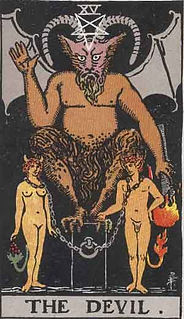
This card is a typical representation of a horned, winged, goat-like Devil. Two naked people are linked to him by chains. To interpret this card as representing all 'evil' as opposed to good would be too simplistic, and the card does not necessarily have to be interpreted in a negative way. This is Dionysus/Bacchus, the god of drunkenness, insanity, and eartly desire - of excess and wild abandon. His followers intoxicate themselves and dance wildly in their ecstatic trance. They may also be greedy materialists. They have utterly lost themselves to baser instincts and emotions, and have returned to the primal and natural state of mankind. Does Dionysus offer ultimate freedom (as his alternative name Eleutherious, 'the liberator' suggests) , or merely tempt us into enslavement?
The Dionysian Devil is a counterpart to the Appolonian Sun. Both promise us great joy. But where Apollo is bright, rational, logical, and self-aware, Dionysus is dark, irrational, chaotic, and he utterly abandons the self. According to the Ancients, the tension between Dionysus and Appolo forms the basis of any great tragedy.
Although following your Dionysian desires is not without risk, this card doesn't say that you should always resist them. The important thing is to be aware of the fact that you are a subject to these desires, as we all are. The beast is in all of us. Be honest with yourself before deciding whether to withstand these powers or to temporarily surrender control to them. Because Dionysus does bring true joy and freedom, in the form of intense rapture, and such unconstrained behavior may have a very important function in our lives. We may grow frustrated with people expecting us to always be responsible, civilized, and seeking their approval. Acting a little wild and crazy every now and then functions as a safety-valve for these frustrations. We may be burdened with social anxiety. Dionysus can free us from self-conscious fear and allow us to participate in deep communal experiences. He overturns the proper order of things, subverts oppressive restraints, and encourages us to act out against societal codes.
If you look closely at the Rider-Waite version of this card, you'll see that the chains are not tight enough to actually prevent these apparently enslaved people from escaping. Ultimately, it is their choice to be under the Devil's power. It is their dangerous task to decide how much they will surrender to the beast within.